
When people come to us about extending their home, the conversation often starts in a similar place. They've been living with a problem for years – a kitchen that feels cut off from the garden, a series of rooms that don’t flow properly, nowhere to put coats or shoes… never enough storage. Generally the house doesn't work the way their family does, and they feel they need more space.
Sometimes they're right. But sometimes, what they actually need is better space. And there's a big difference between the two.
_________________________________________
The Question Before the Answer
Our practice director Susi Wellings spent years working at Richard Rogers Partnership, one of the most influential architectural practices of the 20th century. Rogers was famous not just for the boldness of his buildings – the Centre Pompidou, the Lloyd's Building, Barajas Airport – but for the rigour of his thinking before a single line was drawn.
A principle that stayed with Susi from that time: the most important question when approaching any brief isn't how should we design this? It's what does this actually need to be? Rogers believed that the answer to an architectural problem wasn't always a building. Sometimes it was a reorganisation of what already existed.
And sometimes it was a tree rather than a building at all.
In practice, that principle can be harder to follow than it sounds: it needs the discipline to resist jumping to solutions before you properly understand the problem.
_________________________________________
A Victorian Terrace on Psalter Lane, Sheffield
A family came to us with a house they loved – a Victorian terrace on Psalter Lane in Sheffield – and a kitchen they didn't. It was dark, inward-looking and disconnected from the life happening in the rest of the house and the garden beyond. The question they brought to us was, essentially: what do we do about this?
We could have proposed a large rear extension. We could have suggested a full reconfiguration of the ground floor. Both might have been defensible answers. But we spent time first understanding how this particular family actually moved through their home: where the light came and went throughout the day, what the garden meant to them, where the pinch points in daily life really were.
What emerged wasn't a grand intervention. It was a compact side extension: modest in footprint, precise in intent.
_________________________________________
Small Footprint, Significant Impact
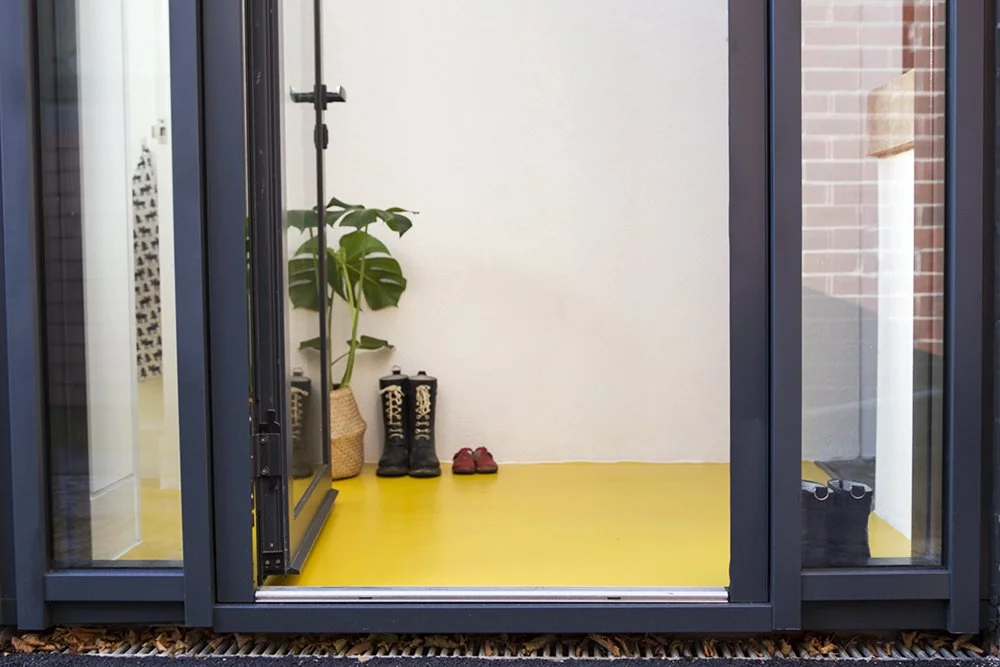
The result – which we've called The Trainspotter's House, after a detail that delighted us during the project – is a glazed volume expressed clearly against the solidity of the existing Victorian brick. Slim metal-framed glazing and a glazed roof draw daylight deep into the plan. Vertical timber cladding softens the new addition and gives it warmth against the surrounding brickwork.
Inside, a bright yellow rubber floor runs continuously through the extension. It sounds like a bold choice, but it earns its place. The colour bounces light into the adjacent spaces, gives the small addition a strong identity, and it’s also robust enough for the realities of everyday family life. A deliberate decision, not a decorative one.
The thresholds between old and new are carefully detailed so the extension reads as distinct but integrated: you know where the Victorian house ends and the new piece begins, but the two feel like parts of the same whole.
Despite its modest footprint, the impact on how the house is used has been significant. Light, clarity and a new spatial rhythm now flow through the kitchen and into the rooms beyond.
_________________________________________
The best extensions are the ones that solve your problem
If you're thinking about an extension, we'd gently encourage you to resist the pull towards maximising square footage before you've properly diagnosed what you need. A well-designed small extension, one that's precisely calibrated to your home's existing character and your family's actual patterns of life, will serve you better than a large one built on assumptions.
The best extensions aren't the ones that add the most space. They're the ones that solve the right problem.
SJW Architects is a RIBA Chartered Practice working across Sheffield, the Peak District and London. If you're considering an extension and would like to talk through what might be right for your home, get in touch.